How Myofascial Lines Connect Your Entire Body
Ever feel a strange pull in your shoulder when you move your hip? Or notice that a tight calf seems to trigger low back pain?
You’re not imagining it…
Your body isn’t a collection of isolated parts—it’s connected by a remarkable, web-like system called fascia. Understanding fascia helps explain why pain often shows up far from the true source of the problem.
At Full Circle Therapy and Wellness we look beyond the “sore spot” to understand how your entire body moves — and how restoring myofascial freedom can unlock lasting relief.
What Is Fascia?
Fascia is a three-dimensional connective tissue network that surrounds and connects every muscle, bone, nerve, and organ in your body. Think of it as a full-body support system that both stabilizes and connects you—while still allowing movement.
The Orange Analogy:
Imagine peeling an orange.
The peel is like your skin —
But the thin white webbing holding each segment together?
That’s fascia.
Why Healthy Fascia Matters
In a healthy body, fascia is hydrated, elastic, and slippery. This allows muscles and joints to glide smoothly. When fascia becomes restricted, movement feels stiff, effortful, and often painful.
Fascia: Your Body’s Sensory & Communication Network
Fascia does much more than hold things together. It contains up to six times more sensory nerve endings than muscle tissue, making it one of your body’s most important information systems.
• Proprioception: Helps your brain know where your body is in space
• Force transmission: Distributes load efficiently during Movement
• Stress response: Responds to physical and emotional tension
This is why pain can feel confusing—or disconnected from the actual problem.
Myofascial Lines: How Your Body Is Connected Head to Toe
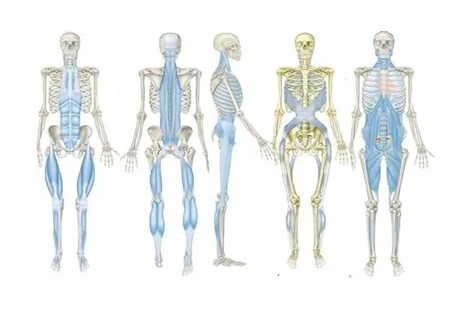
In physical therapy, we often work with myofascial lines (also called fascial slings or chains).
These are continuous pathways of fascia and muscle that span the body. Rather than viewing the body as individual muscles (like quads or biceps), we look at integrated movement systems.
The Domino Effect of Fascial Restrictions
Because these lines are continuous, a restriction in one area can create tension elsewhere—like a snag in a sweater. Tight fascia in your foot can influence your knee, hip, spine, or even your neck.
The Superficial Back Line: A Common Source of “Mystery Pain”
One of the most important myofascial lines is the Superficial Back Line. It runs from the bottom of your feet, up the backs of your legs and spine, and all the way to your forehead.
Real-World Example
• Tight plantar fascia or calves
↓
• Increased tension through the posterior chain
↓
• Stiff neck, upper-back tension, or chronic headaches
In many cases, treating the feet is what finally resolves the neck pain.
How Physical Therapy Restores Myofascial Freedom
When fascia becomes restricted—due to injury, repetitive stress, or prolonged sitting—it behaves more like dried-out Velcro than a smooth gliding system.
Manual Therapy for Fascia
We use skilled, hands-on techniques to restore mobility and hydration to restricted myofascial tissue. This helps transition fascia from a stiff, bound state back into one that moves freely— creating a window of opportunity for better movement.
Whole-Body, Multi-Joint Movement
Because fascia runs in long lines, isolated exercises alone aren’t enough. After manual work, we emphasize multi-joint, functional movements—such as lunging with rotation or reaching patterns—to strengthen and lengthen entire myofascial chains at once.
Did You Know? Fascia Loves Water & Movement
*Fascia is approximately 70% water.
*Healthy fascia behaves like a wet sponge—resilient and springy.
*Dehydration, stress, and inactivity make it sticky and brittle.
*Regular movement literally helps “pump” hydration through the tissue, which is why even a short walk can reduce stiffness.
Ready to Move Better From Head to Toe?
If you’ve been treating the same pain without lasting results, your fascia may be the missing piece. At Full Circle Therapy and Wellness, we perform comprehensive evaluations to identify myofascial restrictions and restore efficient, connected movement—so your body can move the way it was designed to.
👉 Contact us today to schedule your evaluation and experience the difference of whole-body physical therapy, 920-301-7200